Three thousand kilometres from Beijing, on the border with Laos and Myanmar, lies China’s last rainforest. Golden Buddhist temples rise above the jungle, markets overflow with tropical fruit, and you’ll hear the local Dai language more often than Mandarin. It’s a side of China the West rarely sees.
“Most people think they know what China looks like. Then there’s Xishuangbanna.”
Pasta and Panda
We came chasing a rumour about a hidden jungle market, and ended up eating spiders with a local guide who could survive the apocalypse and showed us how. But the deeper we went, the more we noticed something unexpected.
This paradise turned out to be a lot more complicated.
A Tai kingdom inside China
Xishuangbanna doesn’t sound very Chinese, because it isn’t: the name comes from the Tai “Sipsongpanna”. This is the northernmost corner of the Tai world, resting on the Mekong, the river that runs through all of Southeast Asian culture. People here speak a Tai language close to Thai. It’s a Dai Autonomous Prefecture, with its own culture, holidays and religion. Politically, the Dai are Chinese citizens. Culturally, they’re still Tai.
Bitter, sour, spicy: food built for the heat
Forget soy sauce and Sichuan pepper. Here it’s mango sticky rice and papaya salad, and Dai food is our favourite in China precisely because it tastes nothing like the rest of Chinese cuisine. The flavours are bitter, sour and spicy, and each one exists for a reason. Bitterness comes from fermentation, a way to preserve food. Acidity slows the growth of bacteria. And chilli, as counterintuitive as it sounds in the tropics, tricks your body into thinking it’s overheating, so you sweat and cool down.
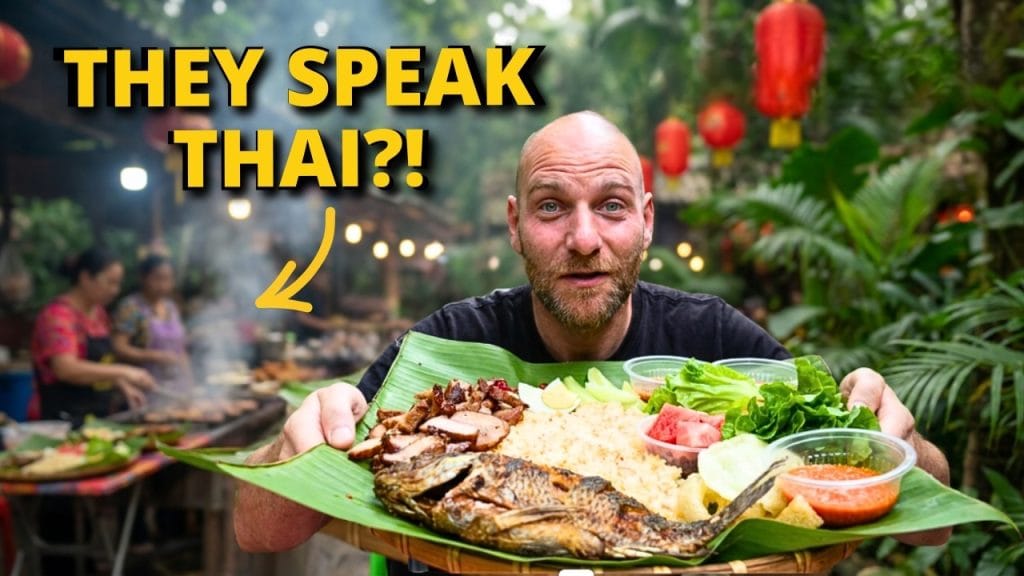
The best way to taste it all at once is the peacock feast: fruit, tangy dipping sauces and plenty of barbecue.
Resorts, a casino and a golden temple
The main city was a lot. Think South Florida with a pinch of Las Vegas, or the resort strip of southern Tenerife: blocks of holiday condos, entertainment everywhere, a proper casino and a night market nothing like we’d imagined. This is China’s tropical escape, where people from the north come for the warmth. We wanted to understand the culture underneath it.
The best place to start is the main Buddhist temple. One look tells you this isn’t the Zen Buddhism of the rest of China: it’s Theravada, the same as in Myanmar, Laos and Thailand. Monks still live and work here, but like much of the Theravada world, Sipsongpanna faces a crisis of the Sangha, the monastic community. With public schools everywhere, families no longer send boys to temples to get an education, so fewer young men become monks. Monks from Laos and Myanmar, the old borderlands of the Dai kingdom, now come to fill the gaps, especially in remote villages where someone still has to perform the rituals and funerals.
Next to the temple are the Dai royal palace, its gardens, and the tomb of the last Dai king, who died in 2017. When the monarchy fell, many of his relatives left China. He stayed, and became a professor at Yunnan University, teaching Dai culture and linguistics.
Stilt houses in the shadow of towers
The palace is where you learn about Dai culture. The old town is where you see it, in the contrast between modern towers and traditional stilt houses. Families lived upstairs and kept animals below. Today the ground floors are shops and barbecue joints. Right next door, the market was piled high with pineapples, watermelons and bananas. It was so hot we kept forgetting it was December.
The market hidden in the rainforest
We kept hearing about a minority market deep in the rainforest, so we spent the night in a tiny town nearby. We stumbled straight into a funfair: it was New Year for the Yao minority, and the whole town was celebrating. We only had our phones, and we filmed anyway.
The market sits in a small village near the Laos border, and it’s easier to find Lao coffee there than any other kind, served with condensed milk. Then we followed the smoke. Rice is cooked inside bamboo until it smells green and slightly sweet. Rice noodles are made by steaming a thin layer of rice paste on a disc over the fire, then hanging and cutting it, a bit like Cantonese rice rolls. A giant sticky rice pancake is roasted until crisp and flaky.
We loaded it with barbecue: ribs, bamboo shoots that taste surprisingly like artichoke hearts, minced meat wrapped in leaves, and purple sticky rice from a bamboo tube. One marinated meat tasted of lime and lemongrass, sweet at first, until the chilli kicked in. For the food and the setting, it was one of the best meals we had in China.
A fifth of China’s life, in one forest
Here’s a fact that stopped us: this rainforest covers just 0.2% of China’s land, yet it’s home to about 20% of the country’s animal and plant species. We explored one of its lesser-known corners, first by boat, where the air turned so cool we wished we’d brought a sweater, then high up on a canopy walkway. It runs through the crowns of the “sky trees”, a species that only grows in tropical climates. Their discovery is what made the world recognise this as a true tropical rainforest. Even up there, the trees towered above us.
Seven hours with a man who could survive anything
The next day we went further inland to find someone who could take us deeper. Our guide knew the jungle like the back of his hand. He showed us the miracle fruit, which turns anything sour sweet in your mouth (they make ice cream with it), and the leaves used as plates at the market, which you can fold into any shape and even cook with over the fire. Then came the briefing: poisonous leaves, snakes and spiders. Stay behind him, do what he does, touch nothing.
The trek was about 6 km, a half-hour jog for locals and four and a half hours for us, through rivers and into a forest that grew darker and colder. Along the way he taught us to get fresh water from banana trunks and fed us snacks: sour ants that burst with acidic juice, and sticky rice with bigger grains than any restaurant’s, dipped in wild mountain honey. He grows that rice himself, in a field right next to the forest, along with watermelons he sells. By the time we were chewing wild sugar cane, hard but very sweet, we were close to seven hours in and exhausted.
A feast of spiders
After a failed attempt at fishing and a short ride on a raft, we sat down to the most delicious meal of the whole trip, and not only because we were starving. Ginger tea came poured from a giant bamboo, dark, complex and full of herbs we couldn’t name, to warm us up after the cold rivers. The bamboo can be reused and even burned two or three times. Our chopsticks were carved from bamboo on the spot, a chicken cooked inside a bamboo trunk, and everything else was wrapped in leaves.
Then the giant orb spiders we’d collected that afternoon. Every guide had told us they were delicious. They taste like barbecue, and we were genuinely surprised by how much we liked them.
The green desert
The forest had given us everything we needed, so it was time to give something back. We planted nut trees and got a small certificate for it, and it’s badly needed. About 20 years ago, the township of Mengla realised rubber was very profitable and turned huge stretches of forest into rubber monoculture, earning the area the nickname “green desert”.
It backfired twice. The original forest floor stored water, and without it came supply problems. And this is the last place in China where Asian elephants roam free, about 300 of them. With their habitat gone, they started raiding villagers’ crops. In 2021 a herd made headlines by walking 500 km north towards Kunming, probably looking for a new home. The government has since created “elephant canteens”, huge plots of bamboo, sugar cane and bananas planted just for them.
Rubber is tapped by cutting the bark every other day so the latex runs into a bowl. Our guide’s family still has plantations that can bring in almost 2,000 yuan a day. The smell is awful, like a small decomposing animal, but he rubbed a leaf on our hands and it vanished. Chewed and pressed on a wound, the same leaf stops bleeding. Monoculture also drains the soil, so here they’ve stopped planting rubber and bring people in to plant native trees instead.
Beneath the resorts
Our guide was Xishuangbanna in human form. He chased the rubber boom, built a business around tourism, and adapted to every wave that hit this place. And still, he walked into the forest and saw food where we saw leaves, medicine where we saw weeds, and tools where we saw nothing at all.
“Borders change, empires come and go, but culture runs deeper than any of that.”
Pasta and Panda
That’s why, underneath the hotels, resorts and tacky night markets, Xishuangbanna still feels like stepping into a Dai kingdom. From here, our journey continued north to Kunming, capital of Yunnan and the city of eternal spring.