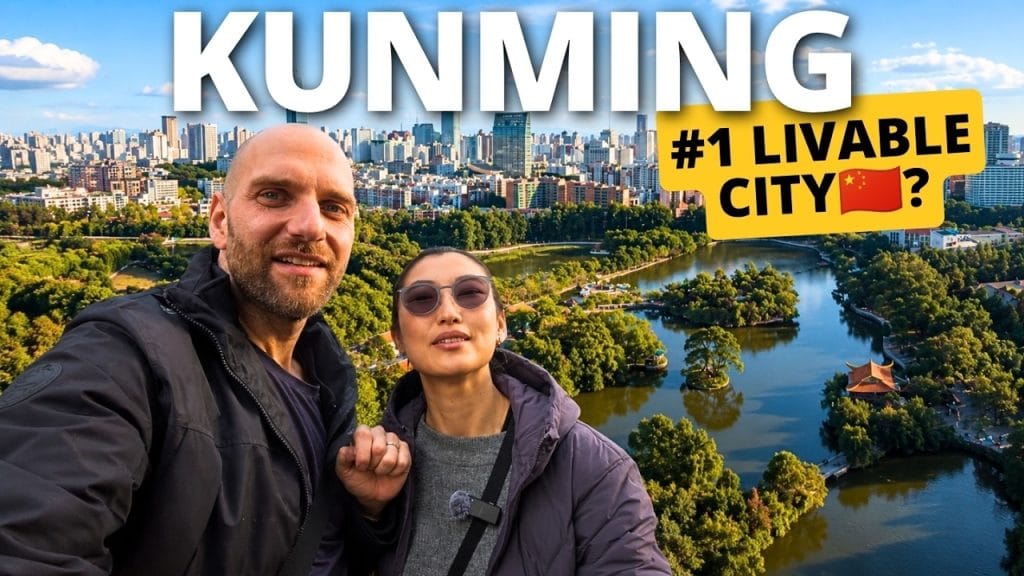
Millions of Chinese people call Kunming the country’s most livable city. We came to find out why, and ended up eating flowers, getting lost in a night market that felt almost illegal, and surviving our worst meal in China less than a day before our best.
“So, is the hype around Kunming real? And what’s life really like in China’s most livable city?”
Pasta and Panda
We filmed this in March, and it already felt like summer. Locals say you can get four seasons in a single day here: 20 to 25 degrees in the afternoon, under 10 at night. Parks, lakes and flowers everywhere, and nature seems to overpower everything.
A city in permanent bloom, with a few surprises hidden between the petals.
The city of flowers, on a plate
In a city this obsessed with flowers, the typical snack is a cake with petals baked inside. We got one rose and one jasmine. Both are so crumbly they fall apart in your hands. The rose hits you before it even reaches your mouth, intense and perfumed. The jasmine is subtle, with an aftertaste a bit like tea. We couldn’t agree on a favourite, so we each kept our own.
Because something is always blooming here, whole shops sell dried flowers, plants and herbs for teas, infusions and even cosmetics.
Coffee country, in China
Nobody thinks of China as a coffee country, yet Yunnan is its biggest coffee-producing region, growing mostly Arabica. Locals like it hand-brewed and lightly roasted. The story we were told is that a German missionary arrived in 1951, felt the climate was like Jamaica’s, and brought coffee beans to try. The brand we tasted comes from one of the first coffee farms in Baoshan.
From the colour you’d never guess how intense it is. The acidic soil makes the beans naturally bright and fruity. One of us found it quite bitter. The other, not so much.
- China Yunnan
- Duration 21:00
Mushrooms, tofu and free spirits
The real star of Yunnan produce is the mushroom, and we may have found the best way to eat it: rice noodles with douhua, a soft tofu, topped with spongy marinated mushrooms. The sauce always sits at the bottom, so you mix everything until it’s coated. There’s sesame paste in there, a spoonful of chilli if you want heat, and a mushroom flavour so deep we kept going back for more. It’s vegetarian, too.
Yunnan attracts China’s free spirits, the alternative crowd, the artisans making their own jewellery, and plenty of foreigners too. Open markets are part of the local culture. In a narrow alley in the culture district we found alternative shops, cocktail bars, coffee bars and an independent music store with a challenge: play the guitar, win a small reward. We played. We won a guitar pick. It was one of the coolest places we saw in China, and everyone was so relaxed.
A night market we weren’t ready for
We’ve been to many night markets in China, but Kunming’s left us speechless. One long stretch is all animals: puppies, kittens, snakes, toads, lizards we’d never seen before, and even flying squirrels. We honestly didn’t know how to feel. We’re already uneasy about zoos, and the cages here were very small. We can’t know how the animals are treated when they’re off display, so we won’t judge, but it didn’t feel good.
It’s also a booming business. Many young people in China choose pets over children, mostly cats, which is why kittens were the biggest sellers, and surprisingly cheap.
The Stone Forest
For Chinese visitors, the Stone Forest is Kunming’s most iconic natural landmark. The entrance put us in a bad mood. As at many big attractions in China, your ticket is checked at one point, and then there’s a 2 km walk to the actual start, which is a very effective way to sell shuttle bus rides. We walked past old ticket machines that used to let you drive up, pay and walk in. To us, parks and forests should feel like public land. Here you pay, you queue, and you exit through a duty-free-style souvenir shop.
Then you see it, and you understand the name. Tall, slim limestone pillars stand like trees, some stacked on top of each other. Limestone forms from ancient marine life compressed over an unimaginably long time, so in a way these are fossils of a prehistoric sea, carved by wind and rain. The best view is from a pavilion built during the Ming dynasty. It’s the most popular spot, and it was packed. Squint a little, and you’re looking at a forest.
There’s an old saying that if you haven’t visited the Stone Forest, you haven’t been to Kunming. It’s also the home of Ashima, the heroine of a tragic love story that became a classic 1964 film our parents and grandparents grew up with. She’s such an icon that there’s even a cigarette brand named after her.
Crossing-the-bridge noodles, and what came next
If there’s one dish you must try in Kunming, it’s guoqiao mixian, crossing-the-bridge noodles. We ordered the thick noodles. The clay pot arrives so hot that the egg cooks as you stir it in, along with quail eggs and meat. Give it a few minutes and everything’s ready. The broth is on the salty side, since it’s the only source of salt in the bowl, with a deep chicken and mushroom flavour.
The name comes from a love story. A scholar was studying for the imperial exam far from home, and every day his wife walked to him with rice noodles, which always arrived cold and clumped. She discovered that a layer of fat on top keeps the soup hot for a long time, so she carried the noodles and toppings separately and combined them when she arrived. The result was a freshly cooked bowl every time.
That night, back at the hotel, one of us got food poisoning like never before, bad enough to nearly faint. It’s so common in Yunnan that locals have a name for it, shuitu bufu: your body hasn’t adapted to the new land and water yet.
A lake that thinks it’s a sea
Luckily, the next morning we could still function, because we had an important mission. On the way, we walked through a wetland park on Dianchi Lake, a few minutes’ drive outside the city, where seagulls come to rest in winter. Locals call lakes like this one, and Erhai in Dali, a “sea”, and standing there you get it. It was windy, the water had waves, and there was no end in sight, even at 2,000 metres, with much higher mountains rising on the far shore.
The mission: picking up our cat, Coconut, at the airport. Our route had two layovers, so we couldn’t fly with him, but within China there are companies that ship pets for a very reasonable price. The family was reunited.
Dounan, Asia’s biggest flower market
Dounan Flower Market is the biggest fresh flower trading centre in Asia, open 24 hours a day, all year round, with some 10,000 traders every day. At half past ten at night it was pumping, and not just with wholesalers. Regular people drop by after dinner because flowers here are dirt cheap. Outside, a bunch of sunflowers cost 13 yuan.
We fell for the Buddha’s hand, a citrus with a strong, almost incense-like scent that sellers say will perfume your bedroom for up to a month. And everywhere, people were filming the flowers on their phones, live streaming on Douyin, the Chinese TikTok. Followers place orders, the streamers buy the flowers, take a commission and ship them. We counted maybe 15 of them in one small corner alone.
A peacock feast
After the noodles, another big meal wasn’t an obvious idea. But it was a special occasion, a birthday, and we’d heard about the peacock feast of the Dai, a minority from the south of Yunnan who consider peacocks and elephants sacred. Their food is close to Thai: sour, spicy and fresh with lime and herbs, with grilled fish, stir-fries, mushrooms, bamboo shoots and three kinds of rice. You eat it with your hands, and they give you gloves.
“There’s not even a party. There’s a rave in my mouth.”
Pasta and Panda
With our eyes open or closed, we’d have sworn we were in Thailand. Less than 24 hours after the worst meal of the trip, it was the best food we’d had in the whole country.
So, is the hype real?
Deep blue skies, great coffee, fresh air, incredible food and flowers everywhere. We see why people call Kunming China’s most livable city. It’s also the gateway to Yunnan, China’s wildest and most diverse region, where we ended up travelling for months.