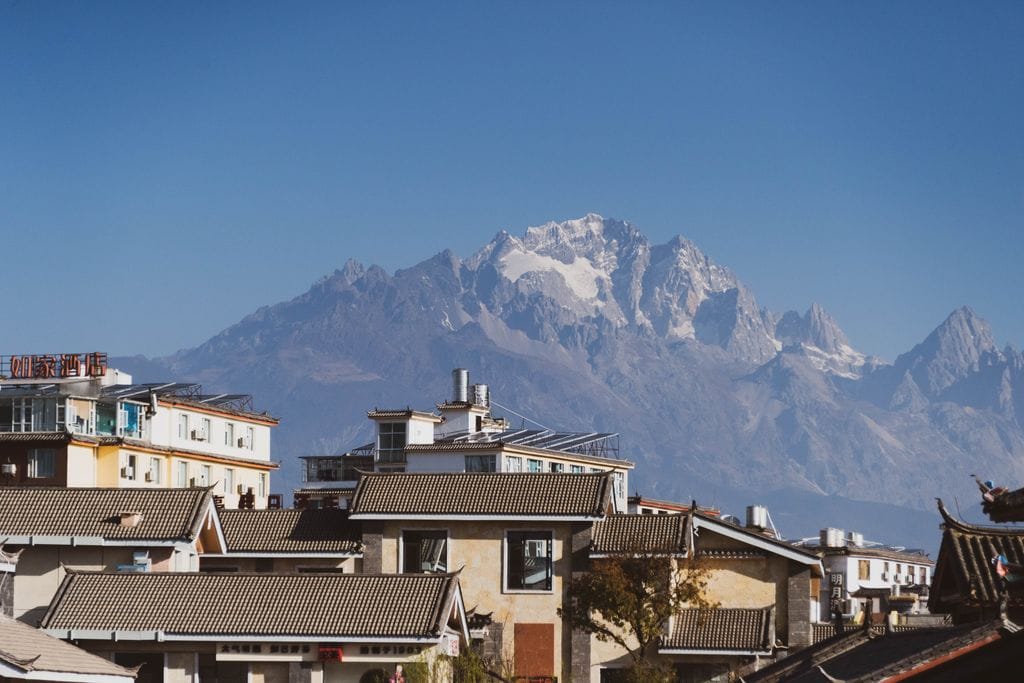
We found what might be the freest place in China, and hardly anyone outside the country knows it exists. Dali sits 2,000 metres up in Yunnan, between a wall of mountains and a giant lake, and it’s where people come for organic farms, festivals and a different way of life.
We came here as one stop on a trip around China. Something about it stopped us in our tracks, and we ended up renovating an abandoned house. So what is it about this place? How did Dali earn the nickname “Dali-fornia”? And just how free is it, really?
We stayed to find out, and it became our home in China.
The Third Month Fair
Dali is the home of the Bai people, and we arrived at the peak of their biggest festival of the year. On the 15th day of the third lunar month, an entire street becomes a bazaar so long you can’t see the end of it. We tasted honey straight from the comb, rolled tobacco leaves, white strawberries that are somehow sweeter than red ones, and a mountain ham said to rival Spanish jamón. We’d put that claim to the test later.
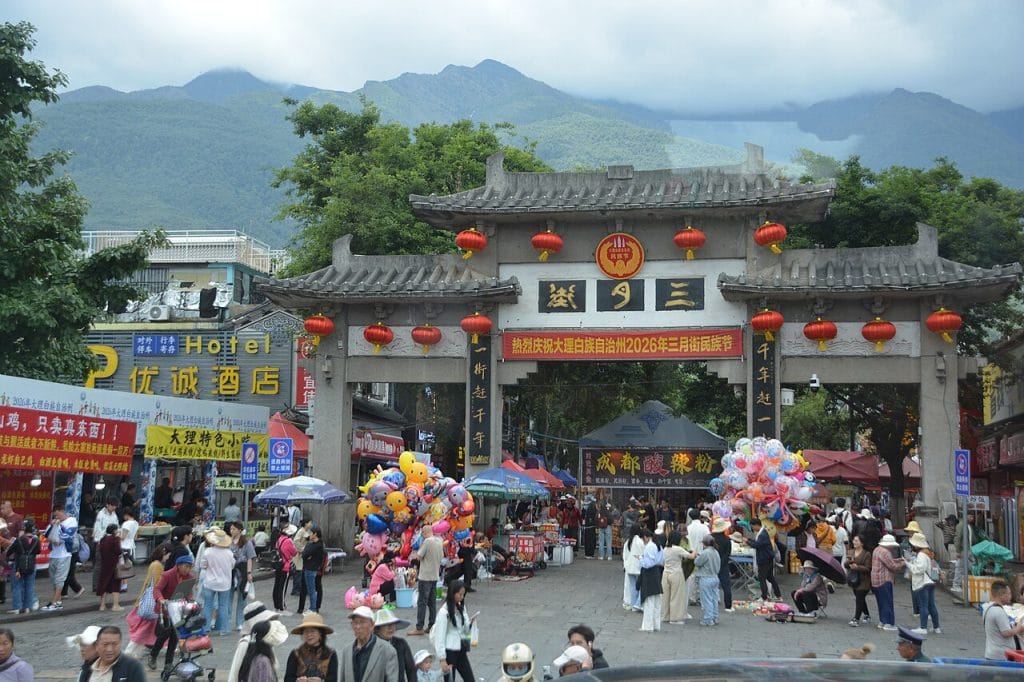
This is the Dali Bai Autonomous Prefecture, which keeps its own holidays and customs, and there are whole villages of Muslim Hui people too. Between the food stalls, young people sell their paintings, clothes and jewellery. Many left big-city nine-to-fives to live closer to nature and make a living from what they love.
A kingdom of monks
To understand why Dali feels so different from the rest of China, you have to go back before the Mongols brought it into the Yuan dynasty. First came the Nanzhao kingdom, ruled by the fierce warrior Yi, and still fierce today, as we’d learn at their fire festival. Then the Bai founded the Kingdom of Dali, a peaceful society rooted deeply in Buddhism. At its heart was a temple in the Cang Mountains so influential that ten of Dali’s 22 kings became monks there.
The hike up is lush with streams and waterfalls, and almost every mountain village has a spring at the top where people fill up with free water, said to be the best for brewing tea. At the temple, you can call a day ahead and join the monks for a meal. First you chant together, then you eat with strangers in complete silence, and at the end you wash your own bowl. It’s a surprisingly beautiful feeling. Foreigners also come to join the kung fu school and live by the monks’ rhythm.
Welcome to Dali-fornia
Below the mountains, Erhai Lake stretches to the horizon, and between the water and the peaks sits Dali Ancient Town. It has everything you’d expect from a Chinese ancient town, like traditional buildings, cherry blossoms and a climate that draws visitors from all over the country. It’s also a magnet for artists, musicians and creatives, whose cafés, studios and workshops give it a completely different energy. That’s where the nickname comes from.
The local must-eat is mixian, rice noodles, often served here with the mushrooms that fill the surrounding mountains. In rainy season, mushroom hot pot is everywhere. Dali’s healthy, organic streak shows up on the plate too, and it’s affordable: our whole table came to about €10 for two.
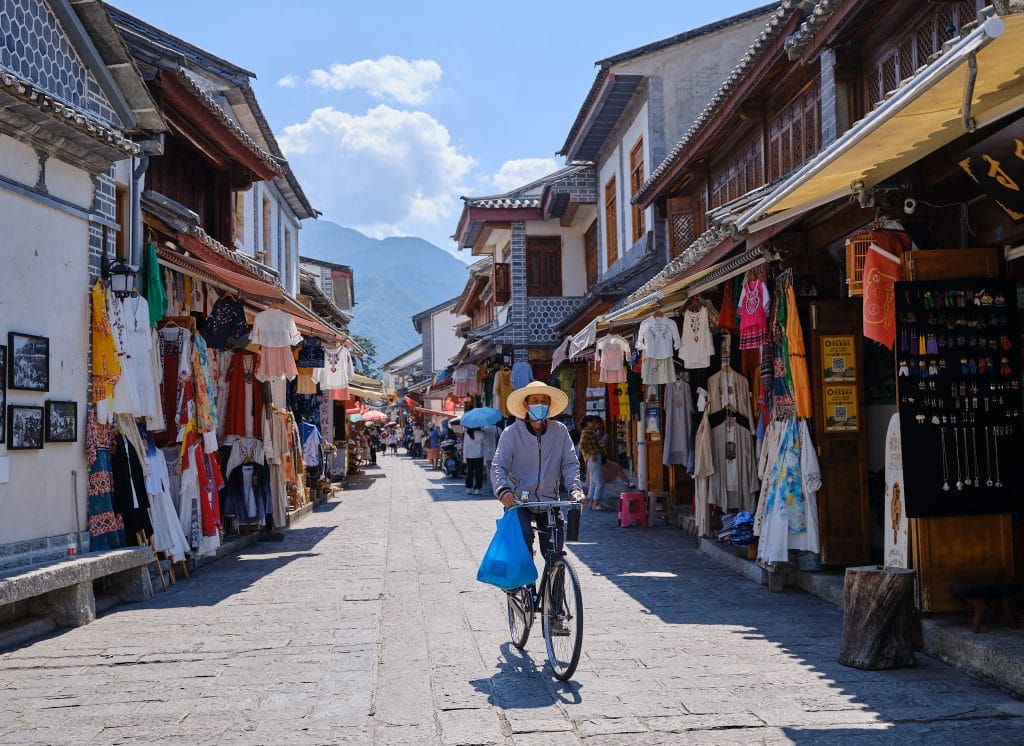
Every Sunday the old town turns into a treasure hunt, as travelling collectors bring their latest finds to the antique market. Old scrolls, embroidery, carvings, and a piece of Tibetan turquoise set in silver going for nearly 8,000 yuan. We watched a seller laugh off a 300-yuan offer for a book, then give in the moment the buyer walked away. Lesson learned: stand your ground, and ideally know what you’re buying.
For dinner we went somewhere special: a half-charity vegetarian restaurant that has served full meals for 5 yuan, well under a euro, since opening in 2009. The Buddhist founder grows the organic vegetables himself. You eat in silence here too, so we didn’t film. We just ate.
The farm, and the invitation
Moving here to grow your own food is a dream many people share, so we spent a day on a working organic farm to see what that life is like. There’s a food forest, a compost toilet, plant enzymes they ferment themselves, their own dairy, and a chicken island instead of a chicken coop. It ended with a yoga class, and when the teacher opened a big window onto the farm and its blossom trees, we just looked at each other.
We also made a friend, who told us about a festival that newcomers from other cities and overseas hold twice a year. We spent the weeks before it in a village on the edge of Dali, waking up in a traditional courtyard house and falling a little more in love with the valley every day. The festival had great music, great food and berries to pick straight from the bushes. Most of all, it had people like us.
“Community was the last piece of the puzzle we needed.”
Pasta and Panda
Hunting for a home
Our first stop was a remote Yi village at 2,200 metres, where a woman had built her dream home from scratch in mud, complete with flowers and peacocks. She had already convinced five outsiders to move up there. One plot with a house and sweeping views was going for about a thousand a year.
When locals told us wild horses still roam the untouched peaks above, we had to go and look. We hiked with our friend Maggie, camped in the forest, and climbed past 3,000 metres, where the air gets thin and every hill feels twice as long.
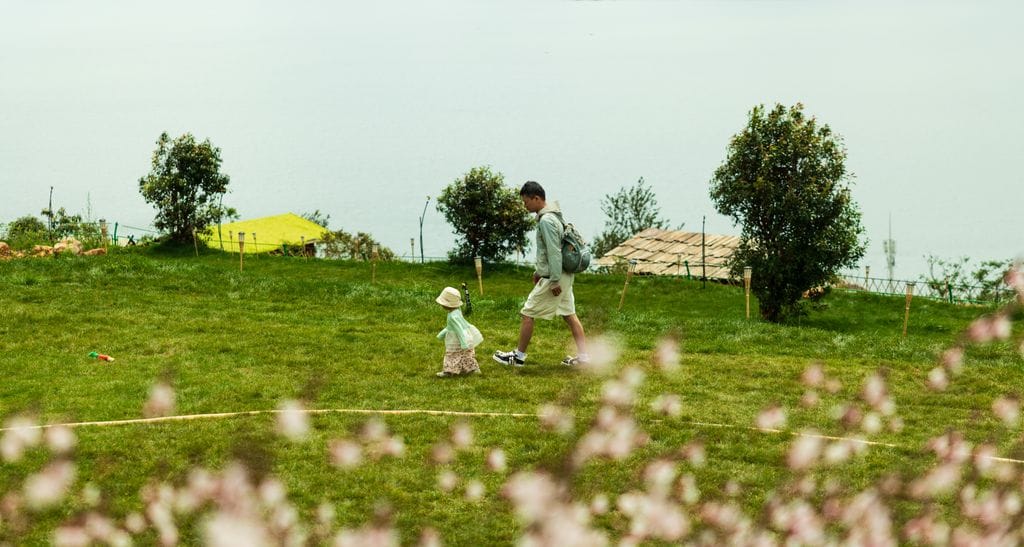
Dali’s best places are scattered in small villages around the lake. Shuanglang, often called the most beautiful, feels almost Mediterranean, like Taormina or a Greek island: blue sky, flowers everywhere, and dogs delivering bouquets with QR codes on their backs so you can scan and pay. There are even seagulls, on a lake 2,000 metres up and very far from any sea. Someone suggested it would be the perfect spot for a pizzeria. The Italian passport qualifies him, surely.
Renting, not buying
We started more simply, with a house that had nothing but columns, outer walls and a roof, plus the best project manager we could have asked for, Mrs. J. The plan: a living room and office, two bedrooms, a big kitchen window, and a small studio for painting, pottery or furniture-making.
We didn’t buy it, and we couldn’t have. In rural China, farmers can own land and build on it, but city people can only rent. We think that’s a good thing. Dali is getting more popular, with fancy cafés opening and Airbnb prices rising. In Lisbon or Barcelona, outsiders buy up homes and locals get priced out. Here, whatever value newcomers add stays with the families who were born here.
Xizhou: the happiness town
Our village sits halfway between Dali and Xizhou, one of the best places to experience Bai food, culture and crafts. The fresh market is the heart of town, with live fish, raw meat and tofu left to mould the way we’d age cheese. Many older women still wear traditional Bai dress every day, and this may be the last generation that does. The “bao” we bought turned out to be a plain steamed bun with nothing inside. The Bai barbecue made up for it, including a spongy fungus that grows on tree trunks.
Then we tried jiama printing, an old Yunnan tradition whose name means “the horse that carries the message”. The message is always a good wish, carved into thousands of woodblock patterns, so whatever you’re wishing for, you’ll find it. Ours reads “good people meet each other”, and Dali is the kind of place where that keeps happening. We met a former stressed-out city worker who now leads people into the mountains to forage pine cones and fallen leaves and turns them into art.
“However you end up here, somehow it gives you the chance to start over.”
Pasta and Panda
A Spaniard’s verdict
Remember the ham from the market? We tracked it down to a remote mountain village, and for an honest verdict we brought our friend Alberto, a true Spaniard and jamón enthusiast. The village cures its ham with salt from a well dug around 190 BC, whose brine is carried by hand and boiled for a full day and night.
The first dry cuts tasted more like beef jerky, so we kept hunting for a slice that melts in your mouth. The verdict: it smells like jamón and tastes like jamón, just a younger, less cured one. It’s very good, but it needs cutting much thinner.
Weishan, and the festival of fire
Our favourite town in the area is Weishan, about 60 km south of Dali, or 20 minutes by fast train. More than half the population is Yi, and you can see it in the clay-and-straw houses. There’s a Confucius temple, ceramic cats on the rooftops to scare off bad spirits, and a hundred-year-old tea house serving local tea with roasted rice. Weishan is famous for mushrooms, including some said to make you see tiny people dancing. It’s also the trippiest ancient town we’ve seen, full of tie-dye and psychedelic rock. Coincidence? Nobody would tell us.
Weishan governs itself by Yi and Hui customs, and one of their holidays is the wildest festival we’ve ever been to: the Torch Festival. We’d heard people end up in hospital with burns every year, and we understood why the moment someone threw a handful of pine resin powder into the fire in front of us. Goodbye, arm hair. The full experience has its own video on our channel.
Coming home
Back in our village, we joined the Bai celebrating their own gods. Instead of following one main religion, each village honours a benzhu, often a real person who did something important for the community and became a god after death. The procession stops at every house, each family lets off firecrackers, and then everyone eats. Our landlord invited us to his feast, where the top delicacy for guests is pig skin, torched, peeled and sliced, served with a spicy, salty, umami sauce. It’s chewier than it is scary.
Our Dali base
After months of chasing contractors, negotiating every detail and hunting for furniture, our little Dali dream came true. A huge thank you to Mrs. J for making it happen. We now have a base in China, but we’re still on the road, and our next stop is Xinjiang, one of the most restricted and fascinating places in the country.